Your Local International Grocery Store Is Subsidizing Your Whole Foods Habit

Your Local International Grocery Store Is Subsidizing Your Whole Foods Habit
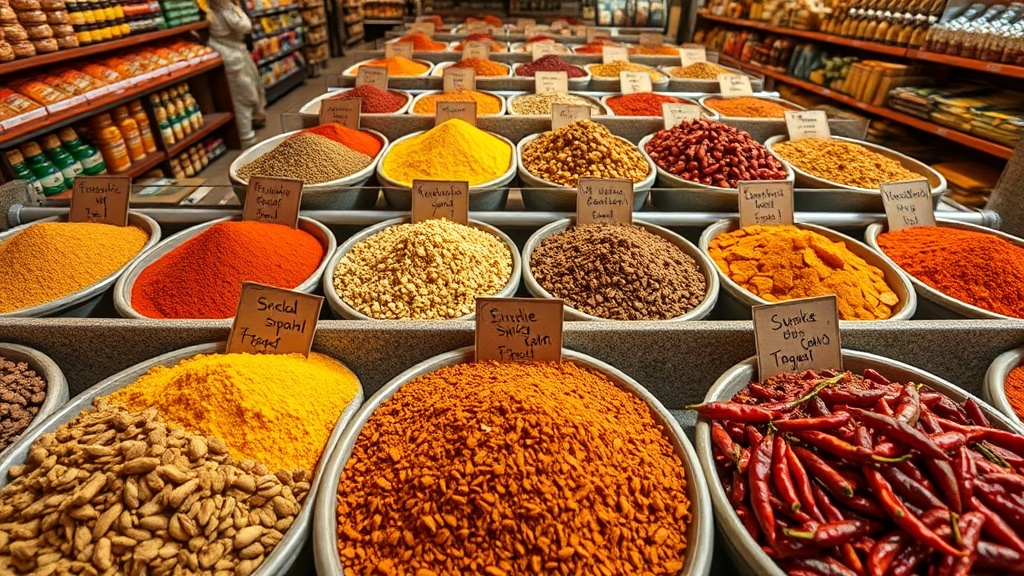
I'm about to say something that might get me uninvited from certain Philly potlucks: if you're buying spices at a regular grocery store, you are getting absolutely robbed.
I don't mean a little overcharged. I mean you're paying 400-800% markups on the same exact product that's sitting on a shelf two miles away at your local Asian, Middle Eastern, or Latin American market. And spices are just the starting line.
The Spice Rack Reality Check
Let's do what we do here—actual math.
A 2.5 oz jar of ground turmeric at a major chain: $4.99. That's $31.94 per pound.
A 7 oz bag of ground turmeric at the Indian grocery store on Chestnut Street: $3.49. That's $7.98 per pound.
Same turmeric. Same country of origin. Same yellow stain on your cutting board. But one costs four times more because it comes in a cute glass jar with a serif font on the label.
Here's my full spice cost comparison from last month:
- Cumin (ground): Chain store $5.49/1.5 oz ($58.56/lb) vs. international market $2.99/7 oz ($6.83/lb). Savings: 88%
- Coriander: Chain $4.79/1.2 oz ($63.87/lb) vs. international $1.99/4 oz ($7.96/lb). Savings: 87%
- Smoked paprika: Chain $6.29/2.12 oz ($47.47/lb) vs. international $3.29/8 oz ($6.58/lb). Savings: 86%
- Whole cardamom pods: Chain $9.99/1 oz ($159.84/lb) vs. international $5.99/3.5 oz ($27.39/lb). Savings: 83%
If you cook regularly and use even five or six spices, switching where you buy them saves $50-75 a year. That's not nothing. That's a week of groceries for me.
It's Not Just Spices
The spice aisle is the gateway drug. Once you start price-comparing, you realize international markets are beating chain stores on a lot of staples:
Rice: A 5 lb bag of jasmine rice at a chain runs $6.99-8.49. At the Asian market? 25 lb bag for $18.99. That's $0.76/lb vs. $1.40-1.70/lb. If rice is a weekly staple for you—and on a budget, it should be—that adds up to $40-60 a year in savings on rice alone.
Dried beans and lentils: Red lentils at the regular store: $2.49 for a 1 lb bag. At the Indian or Middle Eastern market: $4.99 for a 4 lb bag ($1.25/lb). And they usually have varieties your chain store has never heard of—toor dal, chana dal, urad dal—all under $1.50/lb, all complete protein sources that cook in 20-30 minutes.
Produce: This one depends on the store, but international markets that cater to communities that actually cook from scratch tend to move produce fast. High turnover = fresher stock at lower prices. I regularly find cilantro at 3 bunches for $1, ginger at $2.99/lb (vs. $5.99 at the chain), and limes at 10 for $1. Ten limes. For a dollar. At Whole Foods, that's a $7 purchase.
Coconut milk: Chain store: $2.49-3.29 per can. Asian market: $1.29-1.69 per can, and they often have it by the case for even less. If you make curry even once a week, that's $5-8/month in savings on one ingredient.
The "But Is It the Same Quality?" Question
I get this question a lot and I need to be blunt: yes. Often it's better.
International grocery stores frequently source directly from the countries where these ingredients originate. That bag of basmati rice at the Indian market isn't a repackaged version of the same commodity grain—it's often a specific variety, from a specific region, imported by people who actually know and care about the difference between aged and fresh basmati.
The spices turn over faster because the customer base uses them in volume. That jar of turmeric collecting dust at Kroger for 8 months? The bag at the international market was probably on the shelf for 2 weeks before you bought it. Fresher spices = more potent flavor = you use less = even more savings.
The premium branding at chain stores is marketing, not quality. You're paying for the packaging design, the shelf space fees, and the assumption that McCormick's supply chain is somehow superior. It's not. I've done the side-by-side taste tests. The $3.49 bag of turmeric is identical to or better than the $4.99 jar.
My International Market Shopping Strategy
Here's how I actually work these stores into my routine without adding chaos to my week:
1. Monthly spice and staple run. I hit the international market once a month for bulk dry goods—rice, lentils, spices, dried chilies, coconut milk, soy sauce, fish sauce. This single trip replaces $40-60 worth of chain store purchases for about $15-25.
2. Produce opportunism. If the international market is on my route, I pop in for produce. But I don't plan meals around it because their selection varies. I treat it as a bonus—if they have beautiful bok choy for $0.99/lb, that's dinner. If not, I stick to my plan.
3. The "new ingredient" rule. Every visit, I grab one thing I haven't cooked with before. Last month it was black garlic ($3.99 for a whole head vs. $7.99 at the fancy store). The month before, tamarind paste ($1.99). This is how you expand your cooking repertoire without expanding your budget.
4. Freezer integration. Fresh curry leaves, kaffir lime leaves, lemongrass, galangal—these are cheap at international markets and expensive or nonexistent at chains. Buy them, freeze them. They keep for months and add restaurant-quality flavor to budget meals.
The Real Budget Hack Nobody Talks About
Here's the thing that frustrates me about mainstream budget food content: it assumes everyone shops at the same three stores. Aldi, Walmart, Costco. That's the holy trinity of budget grocery advice, and yeah, they're fine. I shop at Aldi religiously.
But international grocery stores exist in almost every mid-sized American city, and the budget food world barely acknowledges them. Why? I have theories, and none of them are flattering to the wellness industry.
The reality is that immigrant communities have been eating well on tight budgets for generations. The knowledge is there. The supply chains are there. The stores are there. You just have to walk through the door.
And when you do, bring a calculator. Because the unit prices will make you angry about every spice jar you've ever bought at a chain store.
The Bottom Line
Adding one international grocery store trip per month to your rotation can save $30-60/month depending on how much you cook. That's $360-720 a year. For reference, that's more than most people save with couponing, and it takes about 45 minutes a month.
No extreme couponing. No app stacking. No loyalty card games. Just walking into a different store and buying the same ingredients for less money.
The math doesn't lie. Your spice rack shouldn't be a luxury purchase.